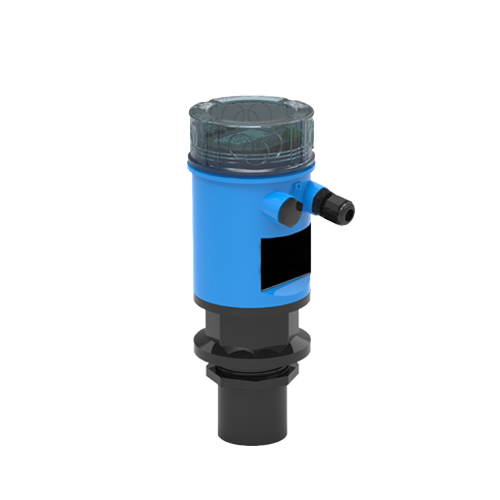

Wastewater treatment is a crucial component of modern urban infrastructure, directly impacting not only the quality of life for city residents but also environmental protection and sustainable development. As an essential measurement tool, level gauges play a significant role in this process. Below are several commonly used wastewater level gauges along with their advantages and disadvantages.
1. Ultrasonic Level Gauge
The working principle of an ultrasonic level gauge is emitting high-frequency sound pulses from an ultrasonic transducer (probe) toward the liquid surface. The probe then receives the echo pulse reflected back from the surface and converts it into an electrical signal. The propagation time of the sound wave is proportional to the distance between the probe and the liquid surface.
Advantages:
(1) Non-contact measurement: ensuring operational stability and reliability.
(2) Broad industrial applicability: Widely deployed in water treatment, chemical processing, food production, and pharmaceutical industries. It is not restricted by the chemical properties of the liquid, making it applicable to various liquids and solid materials.
(3) High measurement precision: Achieves millimeter-level accuracy, equipped with intelligent echo processing and temperature compensation functions to mitigate environmental interference.
(4) Simplified installation: Flexible mounting configurations, with no additional safety protection measures required.
Limitations:
(1) Measurement blind zone: A region near the probe where sound waves cannot be received. The blind zone expands with the increase of the measurement range,necessitating sufficient margin in range selection and avoiding probe installation within this zone.
(2) Sensitive to obstructions: Objects above or around the liquid surface may interfere with sound wave reflection,degrading measurement accuracy.
(3)Limited by medium characteristics: Water vapor, foam, dust, volatile substances, or suspended particles can absorb or distort sound waves, reducing measurement precision.
(4) Poor vibration resistance: Strong vibrations (e.g., from mixers) may cause signal fluctuations and lead to inaccurate readings.
(5) Incompatibility with extreme conditions: Not suitable for high-temperature or high-pressure media. In enclosed containers, temperature differences between the medium and the environment may cause condensation on the probe, impairing measurement accuracy.
2.Magnetic Flip-Plate Level Gauge
This gauge based on the principles of buoyancy and magnetic coupling. As the liquid level in the measured container rises or falls, a magnetic float inside the main tube moves accordingly. The permanent magnet within the float generates a magnetic field that, via magnetic coupling, drives external flip columns (or plates) to rotate 180°. Typically, the flip columns are painted different colors (e.g., red and white): rising liquid levels trigger a white-to-red transition, while falling levels trigger red-to-white. The red-white boundary on the indicator directly reflects the actual liquid level, enabling intuitive visual display.
Advantages:
(1) Easy operation: Simple structure with no need for external power supply.
(2) Intuitive display: Clear, direct reading, ideal for on-site real-time monitoring.
(3) High environmental adaptability: Reliable performance in high-temperature, high-pressure, high-viscosity, and corrosive medium environments.
(4) High compatibility and wide application: Widely used for level measurement in tanks, vats, and similar containers.
Limitations:
(1) High cost: Elevated manufacturing and procurement expenses compared to conventional gauges.
(2) Regular maintenance requirement: For contamination-prone media (e.g., viscous, crystallizable, or particle-containing substances), periodic cleaning of pipeline deposits is necessary to ensure measurement accuracy.
(3) Narrow measurement range: Generally unsuitable for extremely high or low liquid level applications.
3.Static Pressure Level Transmitter
Static pressure level transmitters rely on the principle that the static pressure of a liquid column is proportional to its height, measuring level by detecting the static pressure generated by the liquid. Differential pressure level transmitters extend this principle: changes in liquid level within a container correspond to changes in the static pressure of the liquid column.
The submersible level transmitter, a widely used model, is directly immersed in the measured medium. As the liquid level changes, the static pressure sensed by the internal sensing element (e.g., diffused silicon) varies, enabling accurate level measurement.
Advantages:
(1) Solid-state design: Simple structure with no moving parts, minimizing mechanical failure risks.
(2) Cost-effective installation: Easy to deploy, economical, and durable.
(3) Broad medium compatibility: Suitable for measuring water, oil, and high-viscosity liquids.
(4) High reliability: Unaffected by medium bubbling, sedimentation, or electrical properties; resistant to vibration and impact, with no material wear.
Limitations:
(1) Material and medium constraints: For strong acids, strong alkalis, high-temperature, or high-viscosity media, special corrosion-resistant or high-temperature materials must be selected; Uniform medium density is required,otherwise, measurement accuracy is compromised.
(2) Environmental interference: Accuracy is affected by liquid density, temperature, and liquid column stability, leading to potential cumulative errors. In media containing steam or crystalline substances, measurement errors become more pronounced, requiring anti-scaling or temperature control devices.
(3) Installation location requirements: Must be installed in areas with calm fluid flow and minimal fluctuations. If fluid impact or vibration is unavoidable, an isolation tube should be installed to reduce water disturbance and ensure measurement stability.
(4) Clogging risk in poor water quality: In media with high suspended solids or impurities, pressure tap holes are prone to clogging. Regular cleaning and unclogging of pressure taps are required to maintain accuracy.
4.Radar Level Transmitter
Radar level transmitters are industrial instruments that utilize microwave radar technology to measure the level of liquids, slurries, or granular materials. The antenna emits high-frequency electromagnetic waves (commonly 6 GHz, 26 GHz, or 80 GHz) in a beam toward the medium surface. When the waves encounter the liquid surface or material interface, they reflect back to the antenna. The instrument calculates the distance between the surface and the antenna based on the signal transmission-reception time difference, then outputs a standard signal.
Advantages:
(1) Long service life: Integrated design with no moving parts, eliminating mechanical wear.
(2) Non-contact measurement: No direct contact between the probe and the medium, avoiding corrosion, scaling, and high-temperature damage.
(3) High precision and stability: Minimally affected by environmental factors such as temperature, pressure, and gas composition; suitable for vacuum or high-pressure conditions.
(4) Versatile application: Capable of measuring liquids, slurries, and granular materials, applicable to storage tanks, reactors, reservoirs, and silos.
(5) Strong anti-interference capability, ensuring measurement accuracy.
Limitations:
(1) High cost: Higher procurement and maintenance costs compared to conventional transmitters, especially for high-frequency or explosion-proof models.
(2) Sensitive to medium properties: Low dielectric constant media (e.g., certain organic solvents, liquefied gases, or dry powders) produce weak reflected signals, reducing accuracy. High-frequency models or guided wave radar may be required for such applications.
(3) Foam and agitation interference: Medium foam or stirring-induced vortices can weaken reflected signals, leading to measurement errors.
(4) Strict installation requirements: The probe must be positioned away from tank walls, agitators, and other obstacles. Installation hole length and probe extension must comply with specifications to avoid false echoes or measurement deviations.
(5) Environmental impact: In high-humidity environments, condensation may form on the probe, while dust accumulation or steam absorption can interfere with microwave signals, affecting measurement accuracy. Regular cleaning or the addition of a purging system is required.
In summary, the selection of liquid level sensors should match the characteristics of the medium and the operating environment. Within budget constraints, priority should be given to models offering high accuracy, low maintenance, and long service life, ensuring reliable, stable, and safe operation of liquid level measurement and control.